Research basis
This is a research-based ball-fitting guide, not a USA Golf ball test. It uses independent robot and named launch-monitor evidence to design a reader test. Product scores live only in exact-model Meta Reviews.
Swing speed narrows a golf-ball test; it does not finish it. Two players at 85 mph can need opposite balls because one launches high with too much spin and the other cannot create enough peak height.
Start With the Flight Problem
Swing Speed Is a Starting Point, Not a Compression Gate
Swing speed helps choose useful comparison sleeves, but it does not prescribe one construction or feel. Start with the ball-flight problem you can see. A faster player who launches high with excess spin needs a different test from a faster player whose flight is too flat to hold a green; slower players can have the same split.
Compression Is One Input
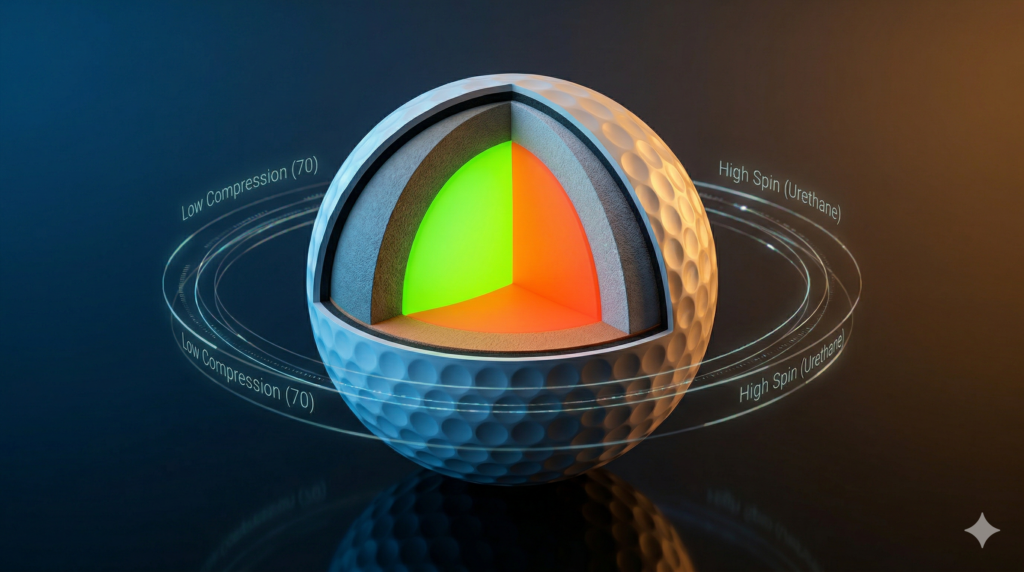
Compression helps describe how a ball deforms, but published robot evidence does not support using one compression cutoff as a universal swing-speed rule. Construction, cover, dimple pattern, and the interaction with each club matter. Treat compression as a comparison clue, not a prescription.
Test the Whole Bag
Begin with driver because a ball that balloons or falls out of the air is easy to reject. Move to a mid-iron and judge carry, height, descent, and rollout. Then test a partial wedge from a repeatable yardage. Finish on the green. A ball that wins only the driver can cost more useful shots elsewhere.
Separate Lower-Spin and Higher-Spin High-Speed Windows
Higher-speed golfers should not treat low spin as the universal goal. One player may need a lower-spinning flight to control ballooning and curve, while another may need more spin, peak height, or descent to keep long approaches playable. Compare those windows only when your current flight shows the need.
Use the same driver, loft, shaft, and ball position when comparing sleeves. Then confirm the choice with a mid-iron and partial wedge so a better tee flight does not create a worse scoring-club tradeoff.
Robot and Human Tests Answer Different Questions
A robot controls delivery and is excellent for isolating product differences. A human test shows how a golfer responds to feel, visual cues, and imperfect strikes. Absolute numbers should not be averaged across speeds, clubs, balls, weather, or launch-monitor systems. Agreement on the shape of the result is more useful than a blended carry number.
A One-Session Fit Card
- Choose three balls with intentionally different flight jobs.
- Use your gamer as the baseline and the same clean clubs throughout.
- Record median driver carry, curve, and peak height—not the longest shot.
- Record mid-iron carry spread and landing behavior.
- Hit ten partial wedges and note predictable carry plus rollout.
- Putt and chip blind to the sleeve when possible; let feel break the tie.
A Simple On-Course A/B Test
Take two finalists to a quiet round and alternate them only when the shots are comparable. Track the driver flight, one repeatable approach yardage, one partial-wedge yardage, and normal chips and putts. Do not decide from one longest drive or one unusually soft green. The better ball is the one that repeats the useful window across the shots you actually face.
Temperature, Wind, and Condition
Cold weather changes ball speed and feel, while wind magnifies flight differences. Compare candidates in similar conditions and avoid drawing a season-long conclusion from one cold sleeve. Inspect covers after bunker and wedge shots, but do not call one scuff a durability rate.
Use the Miss to Break a Tie
When two balls produce similar centered shots, compare the common miss. A high-face driver strike, slight toe strike, thin iron, and low-face wedge can change spin and flight differently. The better gamer is the ball whose imperfect results remain playable, not the ball with the single best center strike.
Do Not Average Incompatible Numbers
A 75-mph robot, a 95-mph robot, and a fast human tester are three different delivery contexts. Launch monitors can also report normalized or modelled flight under selected conditions. Look for agreement in profile—higher, lower, more or less spin—before comparing absolute carry. Never create one “average” yardage from unlike clubs, speeds, balls, or environments.
How to Decide After the Session
Give each candidate a simple red, yellow, or green mark in four jobs: driver window, mid-iron stopping, partial-wedge predictability, and putting/feel. Eliminate any ball with a red in a job you face often. If two remain, use price and cover condition as tie-breakers. Buy one dozen and confirm the choice over several rounds before stocking up.
When a Fitting Chart Helps
Manufacturer charts are useful for identifying intended launch, spin, and feel families. They are not independent performance proof and should not overrule your flight. Use them to select contrasting sleeves, then let the same-club, same-ball-position comparison make the decision.
Buying Checklist
- Confirm the exact model and generation on the box.
- Compare at least three intentionally different flight jobs.
- Use the same clubs and a consistent ball position.
- Judge median flight and the common miss, not one peak shot.
- Check driver, mid-iron, partial wedge, chip, and putt performance.
- Confirm the winner for several rounds before buying in bulk.
Use the Current Shortlist
Our slower-swing-speed Meta Review guide organizes current candidates by flight job and shows why the newest exact generations remain Not Rated instead of inheriting older data.
Bottom Line
Choose the ball that gives your driver a playable window, your irons enough height and stopping power, and your wedges predictable carry. Swing speed is the start of that conversation, not the answer.