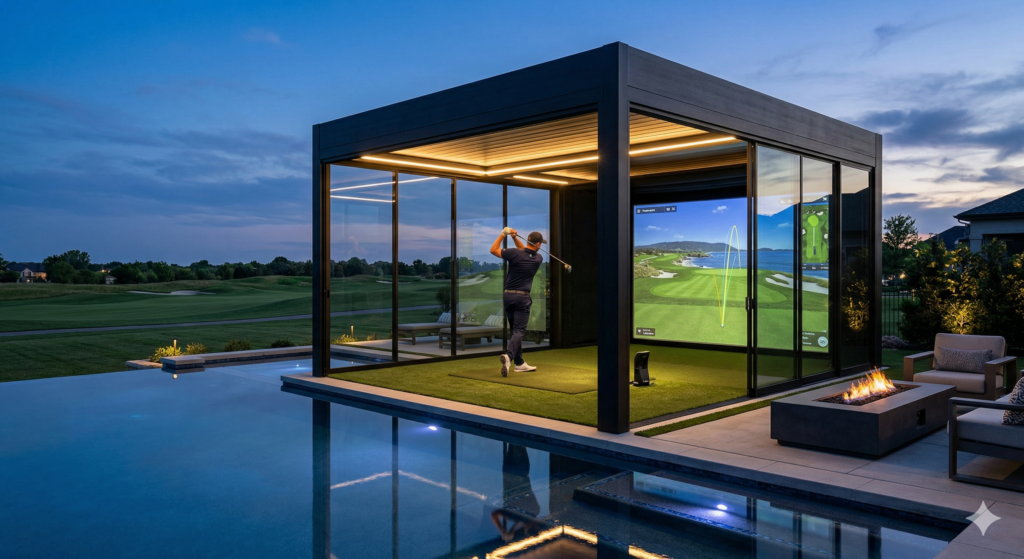
Cabana Golf is marketing a purpose-built outdoor golf simulator for homeowners who lack suitable indoor ceiling height or room depth. The concept is real, but the most useful question is not whether an outdoor simulator looks impressive. It is whether the structure, installation, technology, and total cost fit a specific property.
This is an editorial analysis of information published by Cabana Golf. USA Golf Magazine has not installed or physically tested this system. Product availability, pricing, and specifications can change, so buyers should confirm every detail with the company and a qualified local contractor.
What Cabana Golf says the structure requires
On its official product and FAQ pages, Cabana Golf lists the structure at 17 feet long, 12 feet wide, and 10 feet high. The company says the completed package requires a level deck or concrete pad measuring at least 18 by 13 feet, plus electrical power and Wi-Fi. Those published dimensions should be treated as the starting point, not as a substitute for a site plan.
The company describes an aluminum structure with louvered side panels, roller blinds, a motorized louvered roof, integrated lighting, a projector mounting beam, and built-in power connections. Cabana Golf also says delivery is curbside in multiple boxes and recommends hiring a local contractor familiar with cabana or pergola installation.
The “outdoor” claim needs careful reading
Cabana Golf calls the roof weatherproof when closed and describes drainage and outdoor-rated enclosure components. Those are manufacturer claims, not findings from USA Golf Magazine testing. Before buying, ask for the written warranty, wind and snow-load limits, drainage requirements, temperature and humidity limits for every electronic component, and the exact procedure for securing the structure during severe weather.
A roof that sheds rain does not automatically make a projector, launch monitor, computer, or impact screen suitable for every climate. Michigan freeze-thaw cycles, coastal salt air, heavy snow, high winds, and extreme heat create different installation and storage demands. Get those answers in writing.
What may be included—and what may not be
Cabana Golf sells more than one configuration. Its full-package description includes the structure, simulator enclosure, impact screen, landing surface, hitting mat, projector and mount, launch monitor, cables, and power strip. Its structure-only product requires the buyer to add those simulator components separately. Confirm the exact bill of materials attached to your quote.
The launch monitor matters because radar-based and camera-based systems have different space, lighting, placement, and computer requirements. Confirm that the selected monitor supports outdoor or semi-outdoor operation, that the hitting-to-screen distance meets its instructions, and that the software subscription and compatible computer are included in the budget.
A practical pre-purchase checklist
- Measure the complete swing envelope. Check the structure, pad, backswing, follow-through, projector, and launch-monitor clearance for right- and left-handed players.
- Check local rules. Ask the municipality or homeowners association about setbacks, height, permits, electrical work, drainage, and permanent-structure rules.
- Price the entire project. Include the foundation, delivery access, installation, electrical work, networking, launch monitor, computer, software, screen replacement, and seasonal protection.
- Request warranty documents. Separate the structure warranty from coverage for the roof mechanism, electronics, screen, mat, projector, and launch monitor.
- Plan for noise and ball safety. Confirm side containment, bounce-back protection, property-line distance, and how the enclosure handles a shank or high launch.
- Ask for a local reference. A completed installation in a similar climate is more useful than a general promotional photograph.
Who should consider it
The concept is most relevant to a homeowner with adequate outdoor space, a realistic construction budget, reliable power and internet, and no practical indoor simulator option. It may also fit a club, teaching business, or hospitality property after commercial-use and accessibility requirements are reviewed.
It is a poor fit for renters, small lots, restrictive homeowners associations, exposed high-wind locations, or buyers who want a plug-and-play purchase with no construction coordination. A conventional indoor bay or a simpler net-and-launch-monitor practice area may deliver more value when the primary goal is practice rather than a permanent entertainment space.
Bottom line
Cabana Golf has turned an outdoor simulator into a defined construction product rather than a do-it-yourself collection of parts. That is the useful development. The company’s published specifications make the idea easier to evaluate, but they do not remove the need for property-specific engineering, permits, contractor review, and a complete installed-cost quote.
Named sources
- Cabana Golf official product overview and FAQs, reviewed August 19, 2026.
- Cabana Golf structure-only product page, reviewed August 19, 2026.