Quick Answer
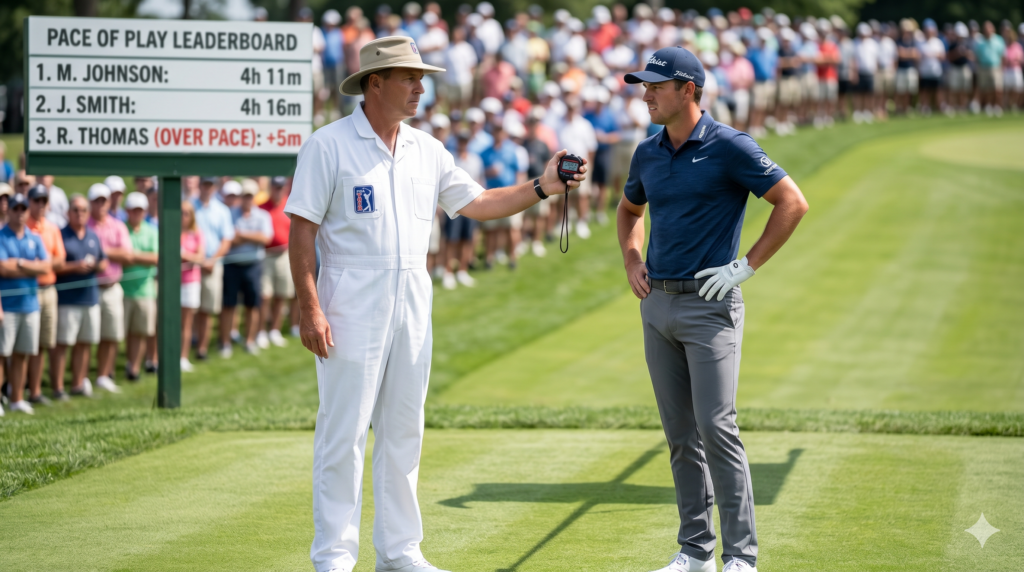
PGA Tour Rule Shift: Official Announcement on the Controversial Pace of Play Policy Effective Post-Masters: The PGA TOUR confirmed post-Masters pace-of-play testing tied to distance devices, pace metrics, and enforcement pressure before broader implementation.
- Category: Tour
- Read Time: 4 min
- Best Use: Apply this as your first decision framework, then validate with your own data.
The PGA TOUR confirmed a post-Masters pace-of-play policy rollout that includes distance-measuring-device testing and expanded pace accountability measures. Commissioner Jay Monahan announced the shift in Ponte Vedra Beach, with testing tied to events between the Masters and PGA Championship windows.
The decision follows sustained criticism of slow rounds and longer final-group completion times during high-visibility weeks.
The policy package is built around two practical levers: data transparency and enforceable consequences. According to CBS Sports reporting, Monahan said the TOUR is “committed to finding the right solutions and making progress on that front.”
Under the published framework, feeder-tour enforcement and timing models were used as the proving ground before broader PGA TOUR implementation decisions.

What Changes Post-Masters
- Distance measuring devices: tested in designated events after the Masters.
- Pace accountability: broader publication of player pace metrics remains part of the policy direction.
- Penalty emphasis: TOUR leadership reiterated that stroke-based penalties are central to behavior change.
Why the Policy Is Controversial
Players and fans largely agree that pace must improve. The debate is over method. Public timing data can increase accountability, but it also creates reputational pressure that some players view as punitive.
Collin Morikawa, quoted by CBS Sports, argued that monetary fines have limited impact and that stroke or points consequences create stronger incentives.
Justin Thomas, also quoted in the same report, said public pace data would “definitely” help curb slow-play issues.
What to Watch Next
The key checkpoint is whether post-Masters testing produces measurable round-time reductions without distorting competitive flow. TOUR officials have signaled that implementation decisions will follow measurable outcomes, not one-week reactions.
If the test phase succeeds, fans should expect faster first-two-round tempo, cleaner broadcast transitions, and more consistent finishing windows late Sunday.
Sources
- CBS Sports: PGA TOUR to allow distance measuring after Masters, test pace policies
- PGA TOUR: Revised pace-of-play policy framework (Americas model)
Related: News section
What This Means for Your Game
PGA Tour Rule Shift is not just a headline topic. It has direct impact on your next purchase, setup, or on-course decision. We added this section to give you practical, reader-first context in plain language.
At USAGolfMagazine, we prioritize verifiable detail and inside-the-ropes tour context. That means comparing tradeoffs, identifying who a recommendation helps most, and showing where fit, budget, or conditions can change the best answer.
Quick Practical Checklist
- Define your primary goal before you copy anyone else’s setup.
- Match choices to your actual swing speed, strike pattern, and course conditions.
- Use one consistent benchmark so comparisons stay fair and repeatable.
- Keep notes after rounds so your next adjustment is based on evidence.
If you apply this framework, your decisions around PGA Tour Rule Shift become clearer, faster, and more repeatable. The goal is not one perfect answer for everyone. The goal is finding the best fit for how you actually play.
As always, revisit this guide after a few rounds and update your plan based on results. Small, measured changes usually beat dramatic overhauls, especially when your objective is long-term consistency.
What This Means for Your Game
PGA Tour Rule Shift is not just a headline topic. It has direct impact on your next purchase, setup, or on-course decision. We added this section to give you practical, reader-first context in plain language.
At USAGolfMagazine, we prioritize verifiable detail and inside-the-ropes tour context. That means comparing tradeoffs, identifying who a recommendation helps most, and showing where fit, budget, or conditions can change the best answer.
Quick Practical Checklist
- Define your primary goal before you copy anyone else’s setup.
- Match choices to your actual swing speed, strike pattern, and course conditions.
- Use one consistent benchmark so comparisons stay fair and repeatable.
- Keep notes after rounds so your next adjustment is based on evidence.
If you apply this framework, your decisions around PGA Tour Rule Shift become clearer, faster, and more repeatable. The goal is not one perfect answer for everyone. The goal is finding the best fit for how you actually play.
As always, revisit this guide after a few rounds and update your plan based on results. Small, measured changes usually beat dramatic overhauls, especially when your objective is long-term consistency.
FAQ
What is the key takeaway from this story?
The PGA TOUR confirmed post-Masters pace-of-play testing tied to distance devices, pace metrics, and enforcement pressure before broader implementation.
Why does this matter right now?
It affects the next decision golfers make, whether that is equipment selection, planning, practice, or competitive context.
Where can I go deeper on this topic?
Use the related links in this section and the category hubs to compare additional models, methods, and scenarios.