Quick Answer
How to Fix an Over-the-Top Move: 4 Transition Keys for Straighter, More Compressed Irons: A practical anti-steep guide with four transition keys, one feedback drill, and a short range plan for straighter, more compressed irons.
- Category: How-To
- Read Time: 4 min
- Best Use: Apply this as your first decision framework, then validate with your own data.
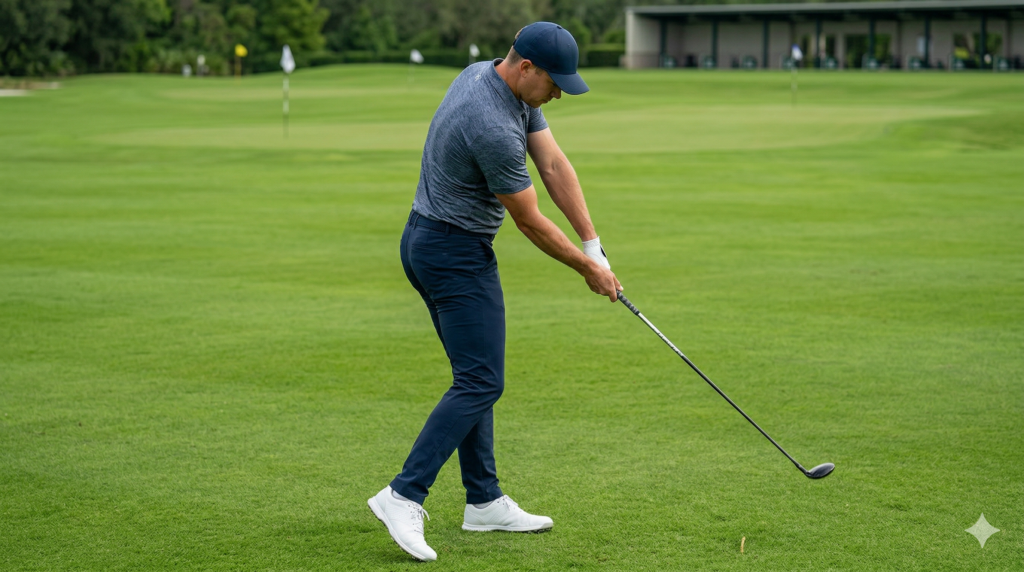
If your irons start left, curve right, or feel glancing instead of compressed, you are likely coming over the top. It feels powerful, but it usually steepens the shaft and forces a last-second face save.
The goal is simple: deliver the club from a better plane with a stable face. You do that by fixing transition sequence, not by swinging harder.
Why the Over-the-Top Pattern Hurts Contact
Over-the-top means your upper body opens early while the club moves outside your hands on the way down. That creates leftward path with inconsistent strike depth and direction.
When transition improves, the club shallows, low point moves forward, and compression becomes easier to repeat under pressure.
The Gear Bag
- Alignment stick: Path reference and body-line check.
- Headcover: Place outside the ball to block steep outside path.
- 8-iron: Best feedback club for strike and start line.
- Phone camera: Down-the-line checkpoint every 8 swings.
4-Step Guide
1) Shift Pressure Before You Turn Hard
Start transition by moving pressure into lead side while your chest stays down for one beat. This creates space for the arms to drop instead of throwing the club out.
Use the cue: shift first, then rotate. If rotation starts first, over-the-top usually returns.
2) Drop Trail Elbow In Front of the Hip
Feel trail elbow move down and in front of your trail hip pocket. This shallows shaft pitch and keeps delivery from cutting across the ball.
Make 3 rehearsal moves for every 1 shot until the elbow path feels automatic.
3) Keep Chest Covering the Ball Through Strike
Maintain posture while rotating through impact. If your chest stands up early, the club gets steep and glancing contact returns quickly.
Think “turn and cover,” not “lift and save.”
4) Use the Headcover Gate for Immediate Feedback
Place a headcover just outside and slightly behind the ball. If you come over the top, you hit it. If you miss it and start balls straighter, transition is improving.
Hit 12 balls with a 2:1 pattern: two rehearsals, one strike.
Pro Tip
Track start line before curve. Cleaner start direction is the earliest sign your path is improving, even before perfect curvature appears.
Common Mistake
Trying to “hold lag” with the hands while the body stalls. That adds tension and often worsens over-the-top delivery. Sequence and space come first; lag appears naturally.
12-Minute Practice Plan
- Minute 1-3: Step 1 pressure-shift rehearsals.
- Minute 4-6: Step 2 elbow-slot pattern at 60% speed.
- Minute 7-9: Step 3 rotation-through-contact reps.
- Minute 10-12: Step 4 headcover gate challenge.
Track two numbers: gate-clear swings out of 10 and centered strikes out of 15. If both rise, your transition pattern is moving in the right direction.
Take It to the Course
Before iron approaches, use one simple trigger: shift, drop, turn. Keep it short and repeatable.
Fixing over-the-top is less about finding one magical feel and more about repeating a better sequence you can trust when the scorecard counts.
Related: Instruction section
What This Means for Your Game
How to Fix an Over-the-Top Move is not just a headline topic. It has direct impact on your next purchase, setup, or on-course decision. We added this section to give you practical, reader-first context in plain language.
At USAGolfMagazine, we prioritize verifiable detail and step-by-step improvement context. That means comparing tradeoffs, identifying who a recommendation helps most, and showing where fit, budget, or conditions can change the best answer.
Quick Practical Checklist
- Define your primary goal before you copy anyone else’s setup.
- Match choices to your actual swing speed, strike pattern, and course conditions.
- Use one consistent benchmark so comparisons stay fair and repeatable.
- Keep notes after rounds so your next adjustment is based on evidence.
If you apply this framework, your decisions around How to Fix an Over-the-Top Move become clearer, faster, and more repeatable. The goal is not one perfect answer for everyone. The goal is finding the best fit for how you actually play.
As always, revisit this guide after a few rounds and update your plan based on results. Small, measured changes usually beat dramatic overhauls, especially when your objective is long-term consistency.
FAQ
What is the fastest way to apply this lesson?
A practical anti-steep guide with four transition keys, one feedback drill, and a short range plan for straighter, more compressed irons.
How often should I practice this move?
Practice in 2 to 3 focused sessions with measurable checkpoints, then keep only the move that holds up under on-course pressure.
What mistake slows progress the most?
Trying to fix everything in one session. Keep one priority and one feedback drill until contact and start line stabilize.